Run Reliable Services Without a Monitoring Team.Infrastructure Monitoring That Just Works.
Bleemeo gives your team full visibility over servers, containers and Kubernetes — dashboards, alerts and logs ready from the first install. You catch incidents before your customers do, your engineers stay on the product, and per-host pricing keeps the bill predictable. European company, data stored in the EU.
No credit card required • 15-day free trial • Production-ready in 5 minutes
Monitoring that thinks ahead
A date, not a red graph
Bleemeo forecasts when disk, memory and swap will run out, from your own history, and puts the date in your weekly report.
Anomalies flagged, never paged
A Chronos-Bolt model learns two weeks of each metric and marks what leaves its usual band. Context for the on-call, not a 3 a.m. wake-up.
Ask your AI assistant
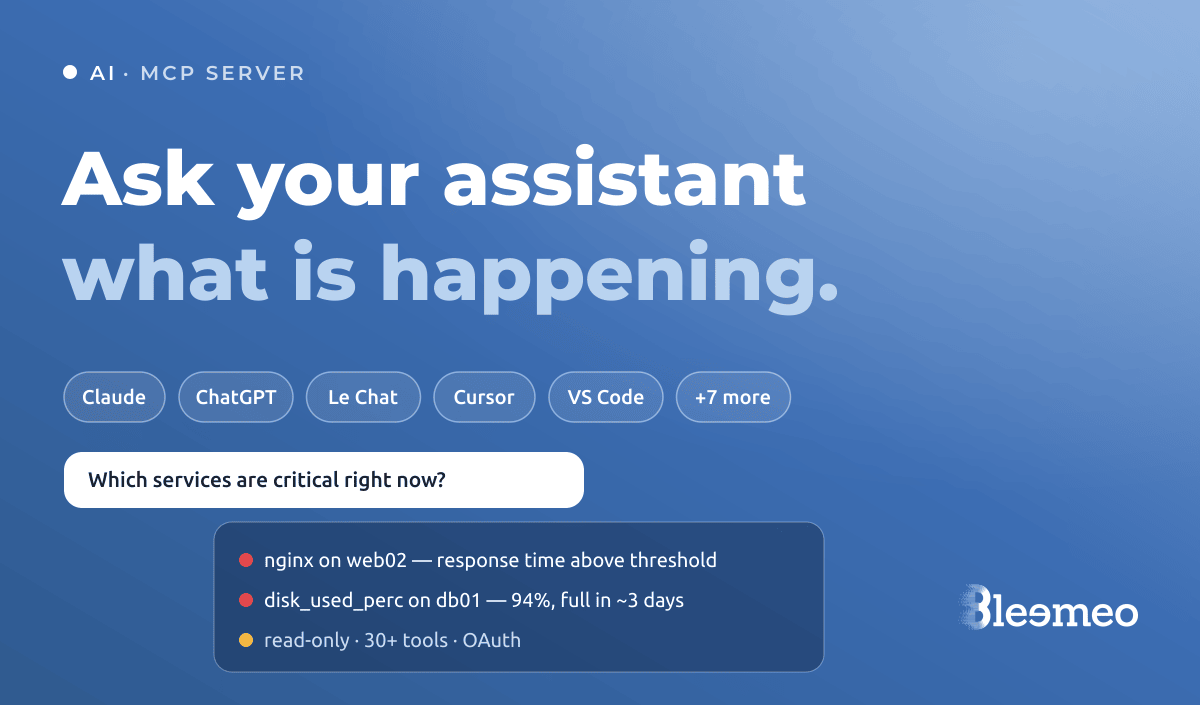
Our MCP server gives Claude, ChatGPT, Mistral Le Chat or Cursor 30+ read-only tools: PromQL queries, metrics, events and logs.
Open standards, no lock-in
PromQL, Prometheus remote write and OpenTelemetry in; an open-source Go agent (Glouton) on your hosts.
One platform
Every Server, Container and Service — One Place to Watch Them
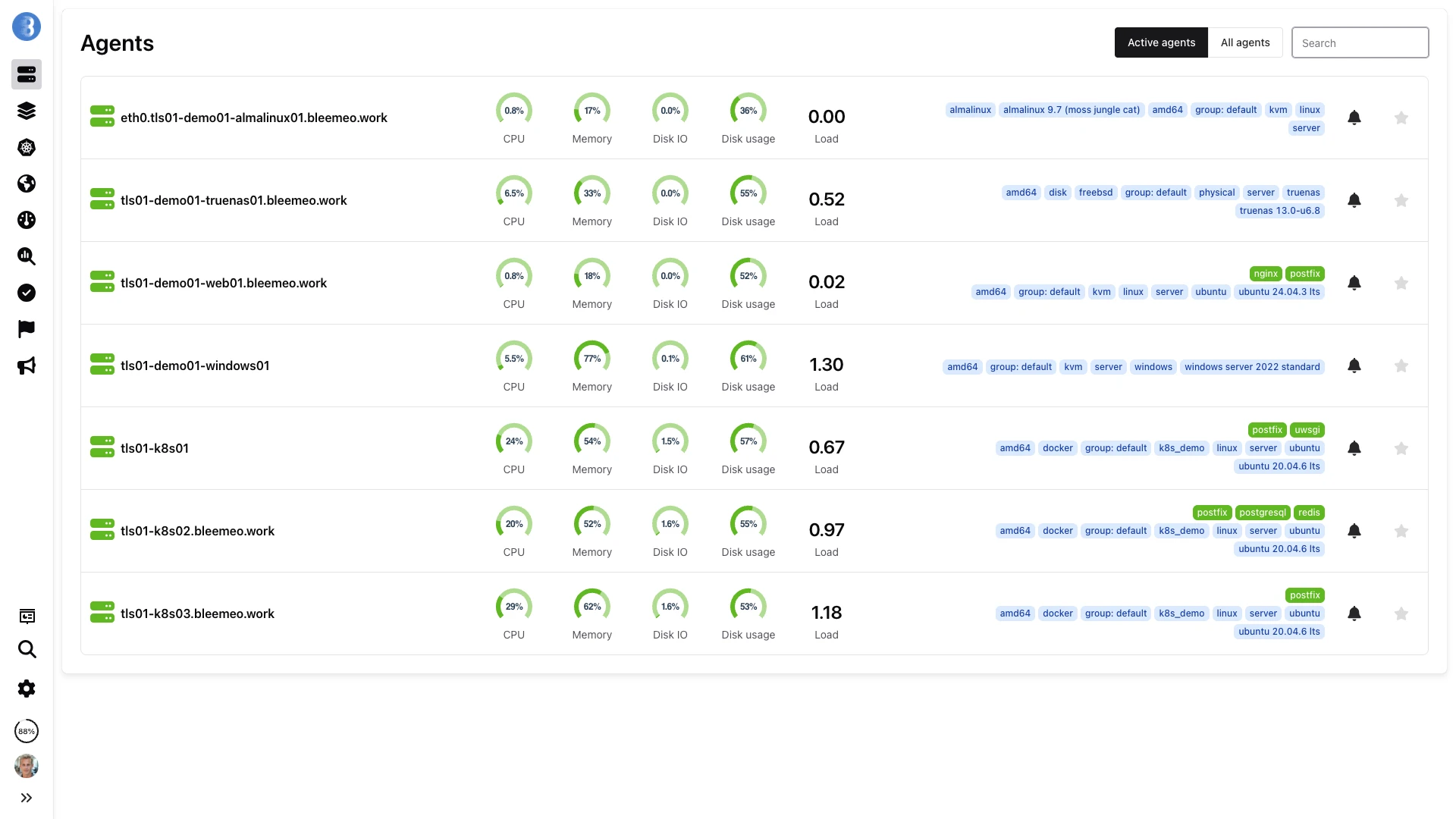
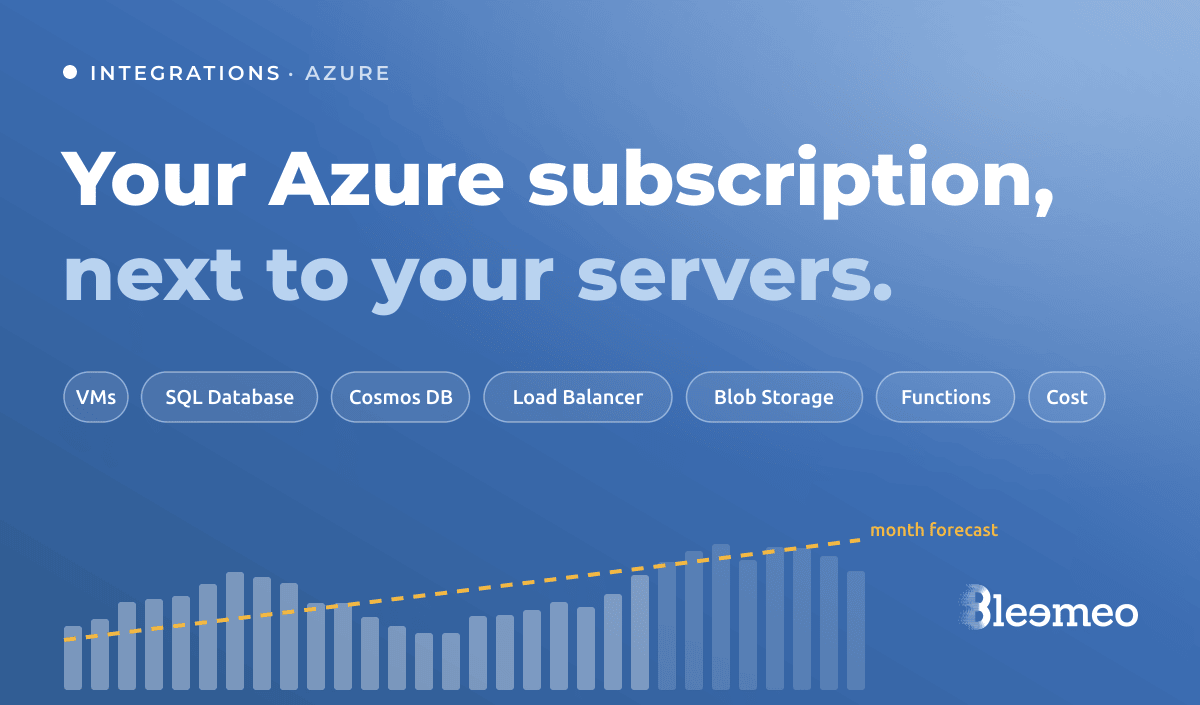
Install one agent on Linux, Windows or Kubernetes and every service on the machine is detected automatically — MySQL, PostgreSQL, Redis, Nginx and more. AWS and Azure services come in through their APIs, network devices over SNMP, and logs land in the same tool. One view of your servers, containers, databases and clouds, without stitching four products together.
Teams That Ship Instead of Babysitting Dashboards
From SaaS startups to mid-size businesses, 500+ companies rely on Bleemeo to keep production running













What Our Customers Say
Engineers and CTOs trust Bleemeo to monitor their infrastructure
We need our teams focused on our core business — digital signage — rather than on infrastructure monitoring. Bleemeo monitors our entire environment, from bare metal to Azure, and frees our teams from useless alerts while guaranteeing our quality of service.

Bleemeo was incredibly fast to deploy. In about an hour we rolled it out across more than 100 servers and immediately gained full visibility into our infrastructure.

We deployed Bleemeo across our server infrastructure in only a few hours. Uptime monitoring now alerts us instantly whenever a service encounters an issue.

Comparison
Build It, Overpay for It, or Just Use It
Build your own stack, buy an enterprise platform, or take the middle path. Here is how the three compare on total cost of ownership — the license fee plus the engineering time to set up, maintain and troubleshoot the monitoring itself.
DIY Open Source
Prometheus + Grafana + Alertmanager + Thanos + ... or Zabbix, Nagios, Centreon, Checkmk- Weeks of initial setup and tuning
- Ongoing maintenance and upgrades
- Storage planning and capacity management
- High availability is your problem
- Full control over everything
- No recurring license cost
The right fit when you already have a platform team with monitoring expertise and the time to dedicate to it.
- Feature-rich and powerful
- Managed infrastructure
- Complex pricing: separate SKUs for hosts, logs, APM and custom metrics
- Bills that grow faster than your infrastructure
- Steep learning curve to get value
- Often more tool than you need
Built for enterprises with big budgets, big teams, and the engineering bandwidth to manage complex observability platforms.
Bleemeo
Turnkey monitoring for growing teams- Production-ready in 5 minutes
- Simple per-host pricing, no hidden fees
- Auto-discovery of 100+ technologies
- 13 months retention included
- Prometheus & OpenTelemetry compatible
- European company, EU data residency
All the visibility you need, none of the overhead you don't. Monitoring that works on day one and scales with you.
What self-hosting really costs
Who monitors the monitoring?
If your monitoring server goes down with the rest, nobody gets the alert. Bleemeo runs outside your infrastructure.
Upgrades and security patches
Prometheus, Grafana, Alertmanager and Thanos are four release cycles to follow. On Bleemeo, there are none.
High availability
Two instances minimum, so you don't lose alerts during maintenance.
Retention
Prometheus keeps 15 days by default; long-term storage means Thanos or Mimir plus object storage. Bleemeo keeps 13 months on Professional.
For 50 servers over 3 years, our calculator counts 17 engineer-days a year of upkeep at €450 a day, 14 days to install and a high-availability pair: €39,397 self-managed, against €19,782 for Bleemeo Professional.
Calculate your own →Fundamentals
What Your Team Gets Back
We run the entire monitoring stack — collection, storage, dashboards, alerting and long-term retention — so the time your team would spend on Prometheus, Grafana, Alertmanager and Thanos goes back into your product.
Visibility from the First Minute
Install one agent and everything is discovered automatically. No exporters to configure, no scrape targets to manage, no dashboards to build from scratch. Glouton detects services via TCP connection probes and adapts when your stack changes — no restart needed.
A Bill You Can Forecast
Simple per-host pricing with no surprise bills. On Professional, each server includes 1,000 metrics and 20 containers; logs are pay-as-you-go per GiB, and users, dashboards and alerts are never billed. You always know what you'll pay — even as your infrastructure grows. Budget monitoring like any other fixed cost.
Alerts Already Tuned for You
Pre-built dashboards, default alert rules, and 13 months of retention included. Get real visibility in minutes, not weeks of setup. Every integration ships with curated dashboards and sensible alert thresholds so you can focus on resolving issues, not configuring tools.
Nothing to Host, Patch or Upgrade
Forget about storage capacity, federation, high availability, and upgrades. We manage the platform — you just use it. No time series databases to tune, no retention policies to configure, no backup strategy to plan for your monitoring data.
Everything you expect from monitoring — included
The basics a monitoring tool has to get right, all in one place, with nothing to install on our side.
Collect
- Linux and Windows servers
- Docker and Kubernetes
- SNMP network devices
- VMware vSphere, AWS and Azure
- 100+ integrations, Prometheus exporters, OTLP
- Custom checks, including Nagios plugins
See
- Real-time dashboards and templates
- 13-month retention (Professional)
- Log search
- Uptime checks from 7 locations, SSL and domain expiry
- Public status pages
Alert
- Default thresholds out of the box
- PromQL alert rules
- Slack, Teams, PagerDuty, Opsgenie, ilert, email, SMS, webhooks
- On-call schedules and escalation
- Silences for maintenance windows
- iOS and Android apps
Operate
- Users, roles and 2FA
- Audit log
- REST API
- MCP server
- Weekly report
Server monitoring
Server Monitoring That Sets Itself Up
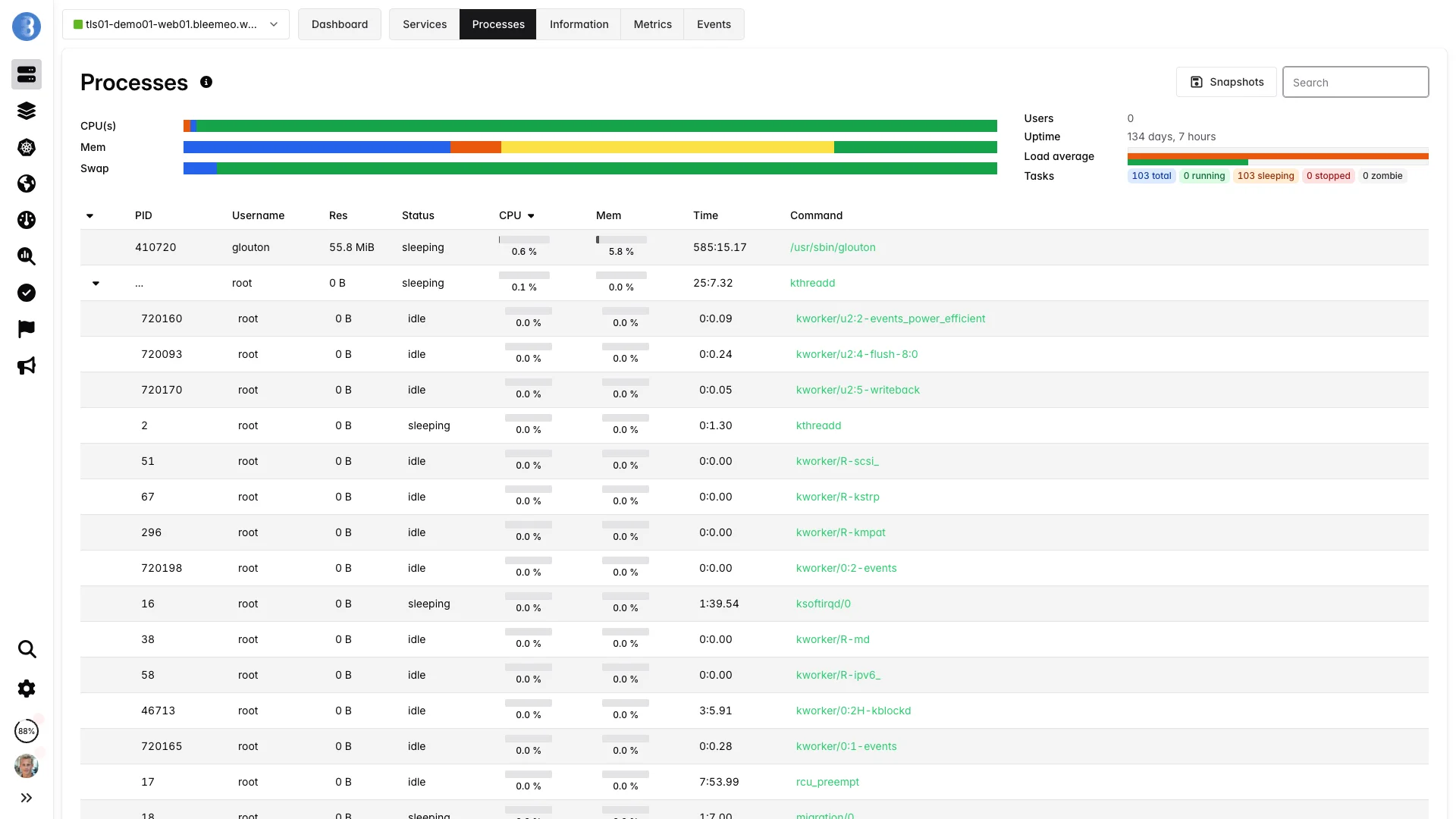
Most monitoring tools require you to define what to monitor, write config files, and build dashboards before seeing a single metric. With Bleemeo, you install one lightweight agent and it does the rest.
Glouton, our open-source agent, automatically discovers every running service — databases, web servers, queues, containers — and starts collecting metrics at 10-second resolution. Dashboards and alerts are ready before you finish your coffee. The agent uses less than 1% CPU, under 100MB of memory, and installs with a single command on Linux, Windows, or via Helm on Kubernetes.
Coverage
From 5 Servers to 500, One Tool
Bleemeo adapts to your stack — not the other way around
Server Monitoring
Physical and virtual servers, VMs, and bare-metal infrastructure. CPU, memory, disk, and network metrics collected every 10 seconds with automatic service discovery and pre-built dashboards.
Explore server monitoring →Kubernetes Monitoring
Complete Kubernetes observability via Helm-deployed DaemonSet. Monitor clusters, nodes, pods, containers, and services with automatic discovery of ephemeral workloads and resource limits tracking.
Explore Kubernetes monitoring →Application Monitoring
Auto-discovered monitoring for MySQL, PostgreSQL, Redis, MongoDB, Nginx, Apache, RabbitMQ, Kafka, and 50+ other services. Track query performance, connection pools, and request latencies out of the box.
Discover application monitoring →Container Monitoring
Docker and containerd metrics out of the box. Track CPU, memory, and network per container. Automatic detection of new containers — no configuration changes needed when you scale up or redeploy.
Explore Docker container monitoring →Network Monitoring
SNMP-based monitoring for switches, routers, firewalls, and load balancers from Cisco, Ubiquiti, Dell, and more. Track bandwidth, error rates, and interface status with uptime checks from global probes.
Explore network monitoring →Cloud Monitoring
Native AWS CloudWatch integration for EC2, RDS, S3, Lambda, ELB, and more. Combine cloud service metrics with OS-level agent data for complete visibility across your cloud infrastructure.
Discover AWS monitoring →Log management
Logs Next to Your Metrics, Billed by the GiB
With most monitoring vendors, logs are a separate product requiring separate infrastructure. With Bleemeo, log collection is built into the same agent you already run — no ELK stack to deploy, no Loki to configure. You only pay for what you ingest at 0.50€/GiB, with no hidden indexing fees or retention surcharges. Collect logs from files, containers, syslog, or via OTLP. Define pattern-based alerts to catch errors before your users do, and correlate log entries with metrics from the same time window for fast root cause analysis.
Prometheus
Love Prometheus? Skip the Ops Work.
Prometheus is powerful — and running it in production means looking after storage, retention, federation, high availability and a constellation of exporters.
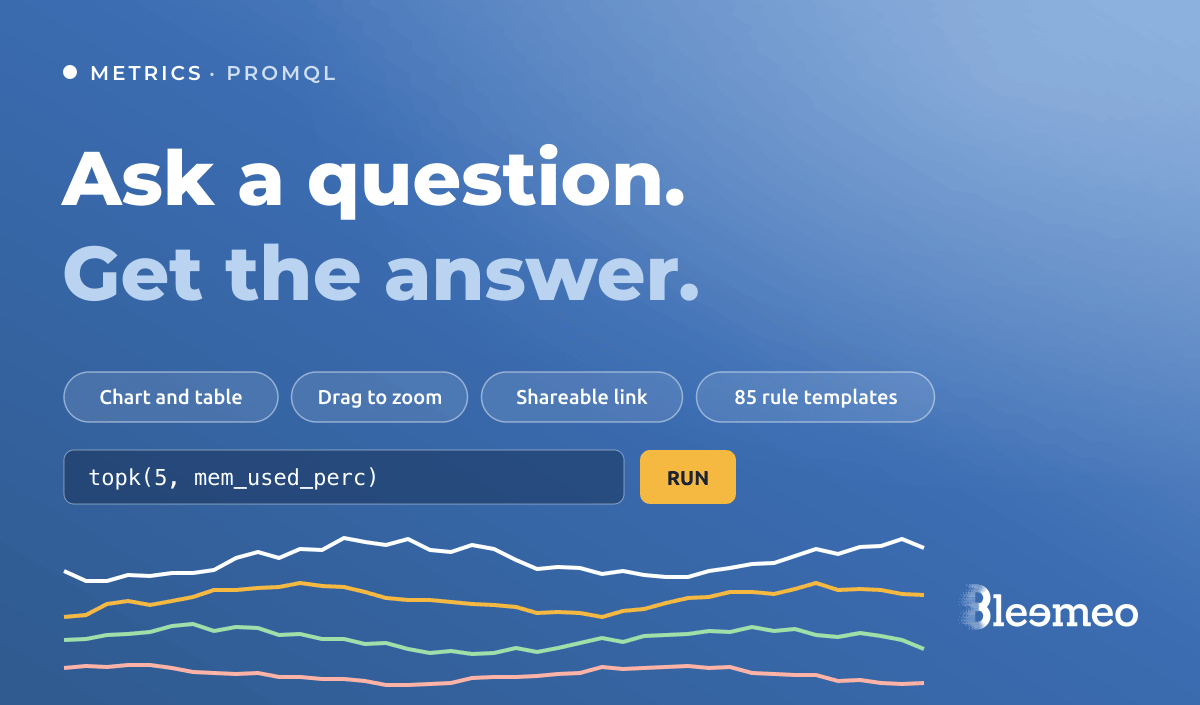
Bleemeo gives you full PromQL compatibility backed by managed long-term storage with 13 months of retention. Keep the query language you know, drop the infrastructure burden. Our agent scrapes your existing Prometheus exporters locally and forwards metrics to the cloud — no Thanos federation, no Cortex cluster, no S3 buckets to size. You get the same PromQL queries you've always written, answered by a database that scales without your intervention.
scrape_configs:
  - job_name: 'nodes'
    static_configs:
      - targets:
        - 'node1:9100'
        - 'node2:9100'

  - job_name: 'kubernetes'
    kubernetes_sd_configs:
- role: podOpenTelemetry
Bring Your Instrumentation. Leave Whenever You Want.
Already using OpenTelemetry or Prometheus exporters? Bleemeo accepts your metrics and logs as-is. No proprietary agents, no vendor-specific SDKs. Your instrumentation stays portable — we just give it a home.
Send metrics and logs via OTLP (gRPC on port 4317, HTTP on port 4318) or let our agent scrape your existing Prometheus exporters. You can run both paths simultaneously — perfect for gradual migrations where you need continuity while switching platforms.
AI & ML
Warned Earlier, Paged Less
Small teams can't afford to chase false alarms. Bleemeo learns the daily and weekly rhythm of CPU, memory and swap on every server and flags the hours that leave the expected range — with no threshold to configure and without paging anyone. A second model answers the other question: not "is this normal right now?" but "when does this run out?"
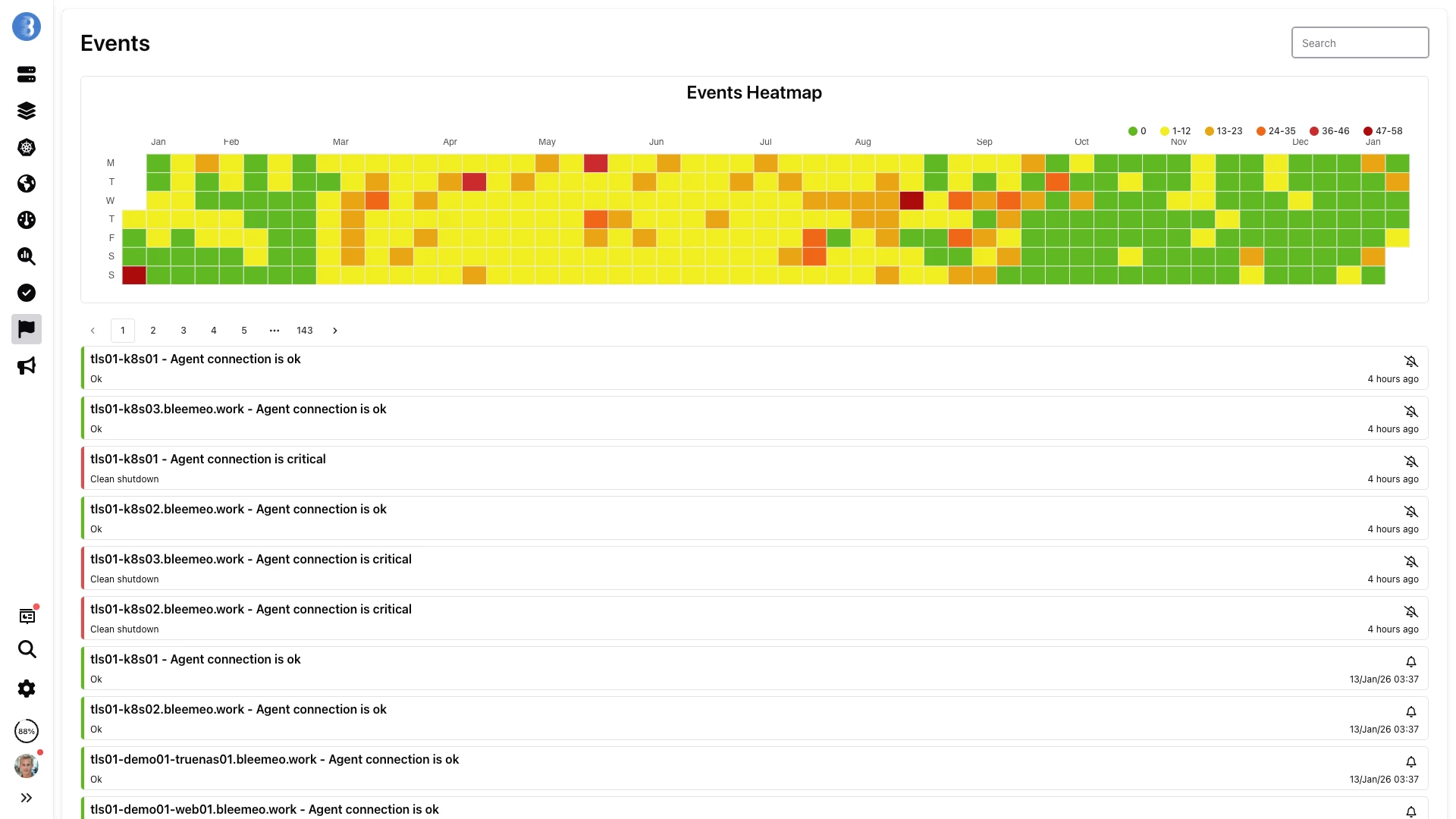
A year of events at a glance — the same history the models read to learn what a normal week looks like.
Anomaly Detection
Bleemeo learns the daily and weekly rhythm of CPU, memory and swap on each server from the last two weeks and flags the hours that leave the expected range. Nothing to configure, and it never pages you: an anomaly is a signal, not a severity.
Capacity Forecasting
Disk, memory and swap trends are projected to a date, not a percentage: "this volume reaches 90% on April 3rd". A date only lands if the drift actually held across two windows — a service that starts and takes half the RAM is not a leak.
Measured Lead Time
Each anomaly is matched with the first alert that followed it on the same host, so the interface shows the real gap — "alert 42 minutes later" — and the median lead per view. You see what the detection is worth on your own infrastructure.
It Learns From Your Answers
Every anomaly takes a yes or no. Repeated false alarms pause detection on that metric on their own, so a noisy signal goes quiet instead of training your team to ignore the feature.
Noise Reduction Suggestions Beta
Bleemeo clusters your recurring alerts and proposes the silence or flappy configuration that would quiet them, prefilled and one click away. Search your event history by meaning rather than exact wording, and ask whether anything like this has been seen before.
MCP Server for AI Assistants
Connect Claude, Cursor or VS Code through our Model Context Protocol server. 30+ read-only tools let an assistant answer questions about your infrastructure health — it can read everything and change nothing.
Security
Your Monitoring Data Is a Map of Your Infrastructure. We Protect It Accordingly.
Security isn't an add-on or an enterprise-tier feature — it's built into every layer of the platform, from the agent running on your servers to the storage where your metrics and logs are retained.
Every agent authenticates with the Bleemeo cloud using unique credentials tied to your account. There are no anonymous data streams and no shared endpoints — each metric source is verified before a single data point is accepted. This means you always know exactly what's reporting into your account, and nothing unauthorized can inject false data into your dashboards.
- TLS 1.3 encryption for all data in transit
- AES-256 encryption for all data at rest
- Per-agent authentication with unique credentials
- Role-based access control and audit logging
European
A European Company, Not Just a European Region
Any vendor can rent a rack in Frankfurt. Fewer can tell you which company you are contracting with, under which law, and exactly what leaves your servers.
You contract with a French company
Bleemeo is a French company, founded in Toulouse in 2015 and run from there. You are invoiced in euros, under French law, with a data protection officer you can actually reach and a support team in your own time zone — not a US entity with an EU subsidiary attached.
Your metrics stay in the Paris region
Metrics and logs are stored in the European Union, in the Paris region. One region, one jurisdiction, named — rather than the "European data centers" every vendor writes. The full list of processors, including the few outside the EU under Standard Contractual Clauses, is on the security page.
No black box on your servers
Glouton, the agent you install, is open source under Apache 2.0. What it collects and what it sends can be read line by line. For anyone who has to justify a supplier, that is a stronger guarantee than a residency badge.
Public status page
Show Your Customers the Uptime You Deliver
The same checks that alert your team also drive a public status page on your own domain: real-time service health, current incidents and uptime history. One URL your support team can share during an incident — no separate status-page tool to buy, nothing to update by hand.
Explore uptime monitoring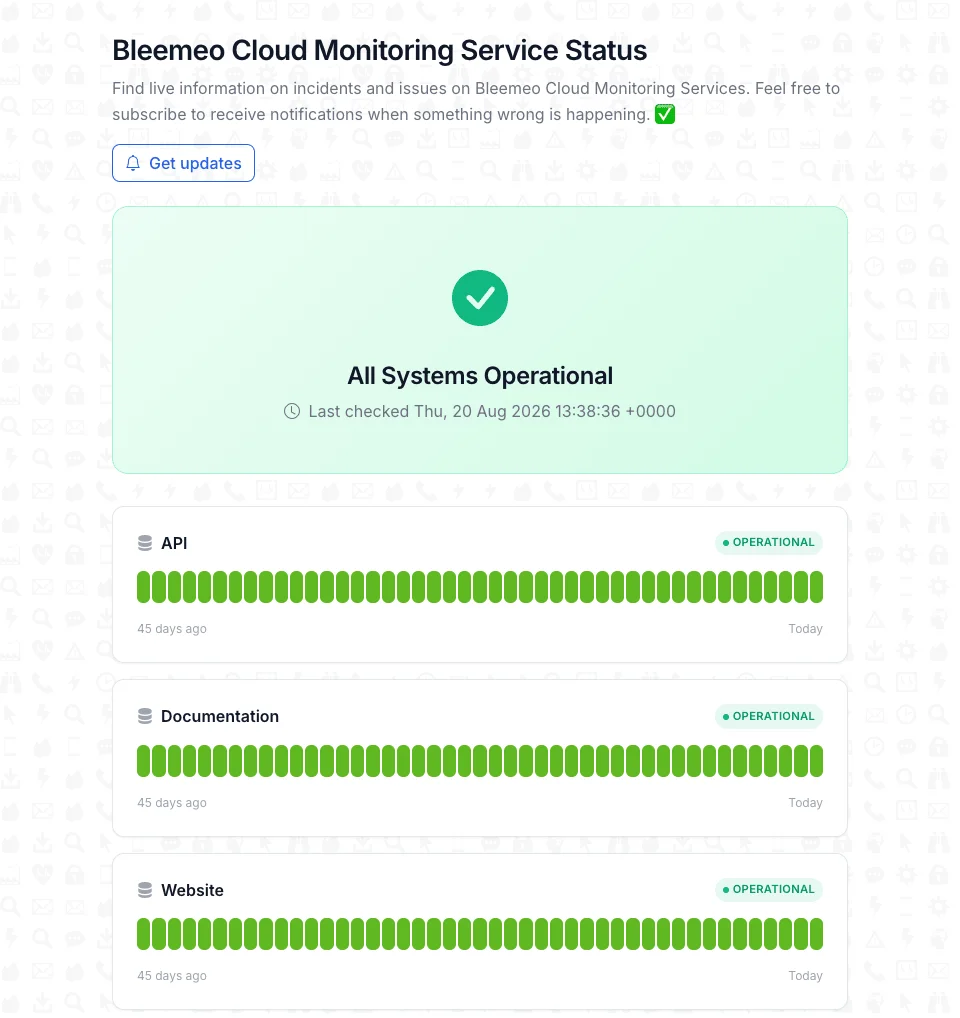
This is Bleemeo's own status page — check it live.
Frequently Asked Questions
Everything you need to know about Bleemeo's monitoring platform
How does your monitoring platform work?
Bleemeo uses a lightweight open-source agent called Glouton that you install on your servers, VMs, or Kubernetes clusters. The agent automatically discovers running services and applications, collects system metrics every 10 seconds, and securely transmits data to our cloud platform. From there, you get real-time dashboards, intelligent alerting, and 13 months of metric retention. For cloud services, we integrate directly with AWS CloudWatch and Azure Monitor. The platform also accepts metrics and logs via OpenTelemetry (OTLP) protocol.
What types of infrastructure and applications do you support?
Bleemeo supports 100+ technologies out of the box with automatic discovery. This includes: Operating systems (Linux, Windows), Containers (Docker, containerd, Kubernetes), Databases (MySQL, PostgreSQL, MongoDB, Redis, Elasticsearch), Web servers (Apache, Nginx, HAProxy), Message queues (RabbitMQ, Kafka), Cloud platforms (AWS, Azure, GCP), and Network devices via SNMP (Cisco, Ubiquiti, Dell). We also support custom metrics through StatsD, Prometheus exporters, and OpenTelemetry instrumentation.
How do you integrate with my existing stack?
Bleemeo offers multiple integration paths: install our Glouton agent for infrastructure monitoring with zero configuration, send metrics and logs via OpenTelemetry (OTLP), or connect cloud accounts through native integrations. For notifications, we integrate with Slack, PagerDuty, OpsGenie, Microsoft Teams, email, SMS, and custom webhooks. No code changes are required for infrastructure monitoring - just install the agent and services are discovered automatically.
Does your monitoring impact system performance?
No. Glouton is extremely lightweight — typically under 1% CPU and less than 100MB of memory. The agent collects metrics asynchronously and batches transmission to minimize network overhead, so it never competes with your production workloads.
How do you ensure data security and privacy?
Security is fundamental to our platform: all data is encrypted in transit using TLS 1.3 and at rest using AES-256, and stored in the EU (Paris region) in line with GDPR. The agent collects system and service metrics — plus your logs if you use log management — and because Glouton is open source, you can verify exactly what leaves your servers. Every agent authenticates with its own credentials over certificate-pinned connections, and access is protected by role-based permissions and audit logging. Our infrastructure undergoes regular security audits.
Do you support metrics and logs?
Yes, Bleemeo provides full observability for metrics and logs. Metrics are collected every 10 seconds with 13 months retention. Logs can be collected and centralized through our agent with real-time search, filtering, and alerting capabilities. Both data types can be correlated in our dashboards for comprehensive troubleshooting.
How quickly can I get started with your solution?
You can be up and running in under 5 minutes. Install our Glouton agent with a single command — one-liner for Linux, installer for Windows, or Helm chart for Kubernetes. The agent auto-discovers your services and populates dashboards immediately.
What makes your platform different from other monitoring tools?
Bleemeo stands out through: Simplicity - automatic discovery means no manual configuration of what to monitor. Open-source agent - Glouton is fully open-source, no black box. Predictable pricing - per-host pricing without hidden metric or data volume charges. Long retention - 13 months included, not 15 days. European company - EU data residency and GDPR-first approach. Standards-based - native Prometheus and OpenTelemetry support means no vendor lock-in.
Do you support OpenTelemetry and Prometheus?
Yes. Bleemeo natively supports both. For Prometheus, our agent scrapes existing exporters and PromQL works out of the box. For OpenTelemetry, send metrics and logs via OTLP (gRPC or HTTP) — no instrumentation changes required.
Is your solution suitable for cloud-native and hybrid environments?
Yes, Bleemeo is designed for modern infrastructure. For cloud-native: we support Kubernetes with full cluster, node, pod, and container visibility via Helm deployment. Auto-discovery handles ephemeral workloads automatically. For hybrid environments: monitor on-premises servers, cloud VMs, containers, and managed services from a single platform. Our agent works identically across environments, and dashboards can combine metrics from all sources for unified visibility.
Latest from Our Blog
Insights, tutorials, and best practices for infrastructure monitoring
Reliability You Can Prove. Costs You Can Predict.
Production-ready in 5 minutes — with the uptime history to show your stakeholders and per-host pricing to plan your budget.
Start Free TrialNo credit card required • 15-day free trial • Full feature access