Connect EverythingYou Monitor
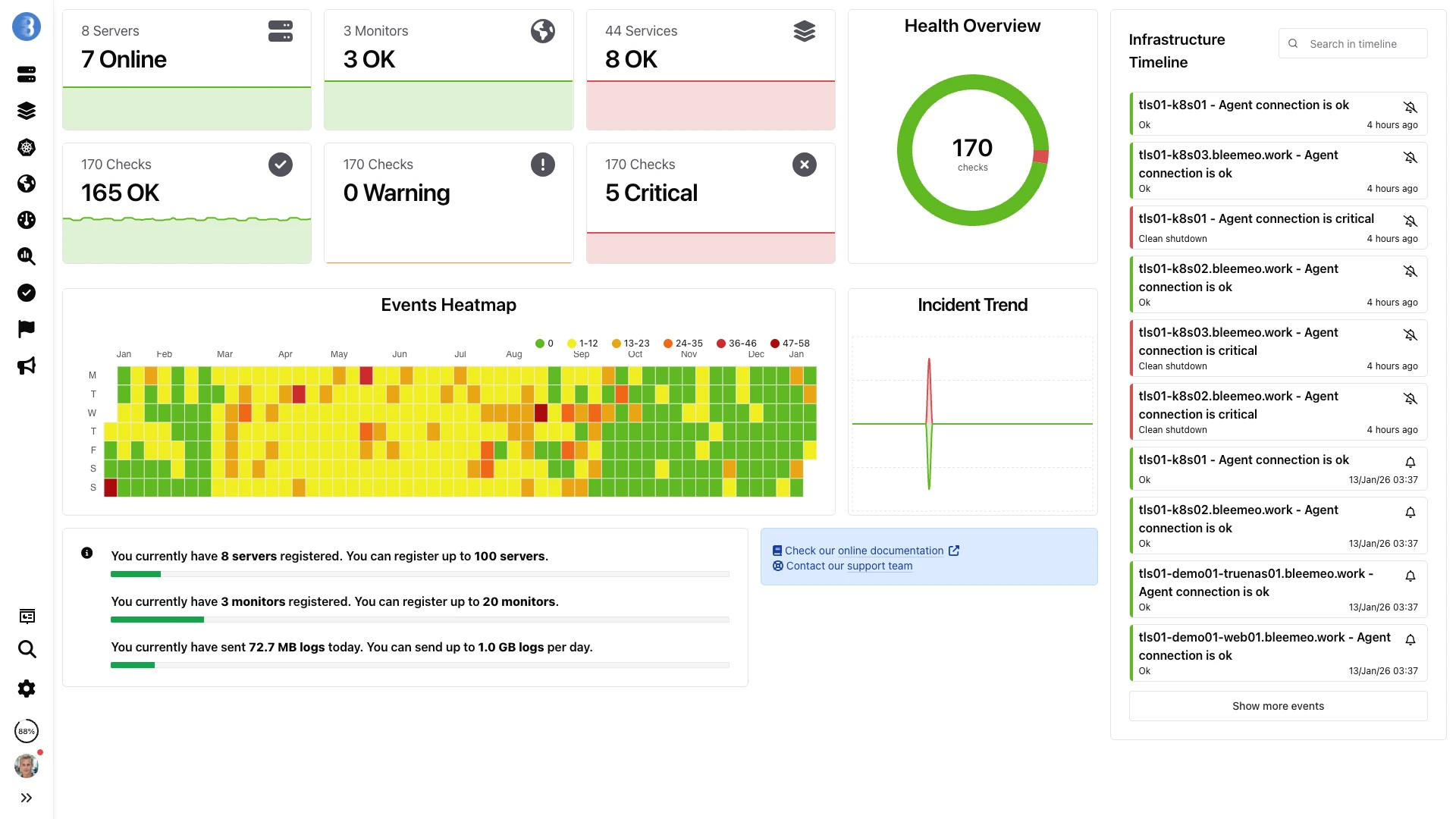
Bleemeo seamlessly integrates with your entire technology stack, supporting over 100 technologies with new ones added regularly. From databases and web servers to containers and cloud platforms, get comprehensive monitoring powered by automatic discovery. The Glouton agent automatically detects running services using TCP socket probes, requiring no manual configuration on your part. Once a service is detected, it immediately receives dedicated metrics, pre-configured alerts, and purpose-built dashboards tailored to that technology. You can also bring your own custom metrics via Prometheus endpoints, OpenMetrics, StatsD, and Nagios plugins for complete observability across every layer of your infrastructure.
How it works
How Auto-Discovery Works
When you install the Glouton agent on a server, it immediately begins scanning for running
services using TCP socket checks executed every 60 seconds. There is nothing to configure:
Glouton probes well-known ports and identifies the technology behind each open socket, whether
it is MySQL on port 3306, Nginx on port 80, or Redis on port 6379. Each detected service
receives a service_status metric that reports one of four values: 0 (OK),
1 (Warning), 2 (Error), or 3 (Unknown/timeout). This gives you an at-a-glance health
indicator for every service running on the host.
Instant failure detection
Between polling intervals, Glouton maintains keep-alive connections to critical services. This means that if a service crashes or becomes unreachable, failure detection is immediate rather than waiting for the next 60-second cycle.
Automatic tagging
Detected services are automatically tagged with metadata such as the service name, port, and host, so they appear in your Bleemeo dashboards and alert rules without any manual configuration. You get full visibility from the moment the agent starts running.
After detection
What Happens After Detection
Service status metric
When the Glouton agent detects a service, several things happen automatically. First, the service receives a service_status metric that tracks availability with values from 0 (OK) to 3 (unknown/timeout). This metric triggers default alerts if the service becomes unavailable — no configuration needed.
Service-specific metrics
Second, the agent begins collecting service-specific metrics that go far beyond simple availability. For a MySQL database, you get queries per second, slow queries, connection pool usage, buffer pool hit ratio, and replication lag. For Nginx, you get active connections, requests per second, response status codes, and upstream response times. For Redis, you get memory usage, key eviction rates, connected clients, and command latency. Each integration has its own set of curated metrics designed by monitoring engineers who understand what matters for that technology.
Automatic tags
Third, Bleemeo automatically creates a tag for each detected service. Tags make it easy to filter dashboards, scope alert rules, and organize your infrastructure. A server running MySQL, Nginx, and Redis automatically gets three service tags, which you can use to create targeted notification rules — send database alerts to the DBA team, web server alerts to the platform team.
Pre-built dashboards
Finally, pre-built dashboards populate with the collected metrics as soon as data starts flowing. You don't need to build dashboards from scratch for common services. The agent dashboard for each server includes a Services tab showing all detected services and their key metrics at a glance.
Operating Systems

AlmaLinux

CentOS
CloudLinux

Debian

Fedora

Oracle Linux

Proxmox Backup Server

Proxmox VE

Red Hat

Rocky Linux

TrueNAS CORE

TrueNAS SCALE

Ubuntu

Windows Server
Databases

Cassandra

ClickHouse

CockroachDB

CouchBase

CouchDB

Elasticsearch

InfluxDB
MariaDB

Memcached

MongoDB


PostgreSQL


RethinkDB

Riak

SQL Server

Valkey
Web Servers & Proxies

Apache HTTP

Caddy

Emissary

Envoy

HAProxy


Squid

Traefik

Varnish
Message Queues & Brokers

Kafka

Mosquitto

NATS


RabbitMQ
Container & Orchestration

Docker
Kubernetes
Monitoring & Observability

Graphite

Nagios Plugins

OpenTelemetry

Prometheus


Telegraf
Application Servers & Runtimes

.NET


Erlang


Java

Node.js

PHP-FPM

Python

Ruby

Rust

uWSGI
Configuration Management




Communication & Mail

Asterisk

Dovecot

eJabberd

Exim

Postfix
Infrastructure Services

Authentik

BIND

Consul
CoreDNS

etcd

FreeRADIUS

Infisical

libvirt

OpenLDAP

OpenVPN

Minio

PowerDNS

RustFS

UPS (upsd)

Vault

ZooKeeper
Alerting & Notifications

Discord


MessageBird

OpsGenie

OVH SMS

PagerDuty

Slack

Microsoft Teams

Telegram

Twilio

VictorOps

Webhooks

Rocket.Chat
Cloud Platforms


AWS CloudWatch

AWS EC2

AWS ELB

AWS DynamoDB

AWS RDS

AWS S3
Development & Collaboration

Bitbucket

Confluence

Forgejo

Gitea

GitLab

Jenkins

JIRA

GitHub
Mobile Applications


Other
VMware

NVIDIA
Configuration
Configuration Flexibility
Override defaults when you need to, or let auto-discovery handle everything
YAML Configuration
Override any service setting via YAML files at /etc/glouton/conf.d/. Files are read lexicographically and merged, so you can layer team defaults with environment-specific overrides. Changes are detected automatically without agent restart. Use two-digit prefixes (e.g., 30-mysql.conf, 50-custom.conf) to control the order in which files are merged.
Docker Labels
Configure monitoring per container using Docker labels like glouton.check.ignore.port.8080=true to skip specific ports, or glouton.enable=false to exclude containers entirely. Labels are detected in real-time as containers start and stop. This approach works seamlessly with Docker Compose, Swarm, and standalone containers.
Kubernetes Annotations
Use pod annotations to control monitoring at the Kubernetes level. Enable Prometheus scraping with prometheus.io/scrape, specify custom ports with prometheus.io/port, and filter by namespace. All changes apply without redeploying the Glouton DaemonSet. Annotations are evaluated in real-time, so monitoring adapts instantly as pods are created, scaled, or terminated.
Environment Variables
Override any configuration setting with GLOUTON_ prefixed environment variables. Perfect for cloud deployments where file-based configuration is impractical. Supports strings, integers, booleans, and even nested settings. This is the recommended approach for containerized deployments and CI/CD pipelines where configuration is injected at runtime.
Don't See Your Technology?
Bleemeo supports custom metrics through Prometheus, OpenMetrics, StatsD, and Nagios plugin protocols. If you're running a service that isn't in our catalog, chances are you can still monitor it. Use our API for complete flexibility, or contact us to request native support for your technology.